Although written history of the city of Worthington began in 1803, the history of people in central Ohio extends for thousands of years before that.
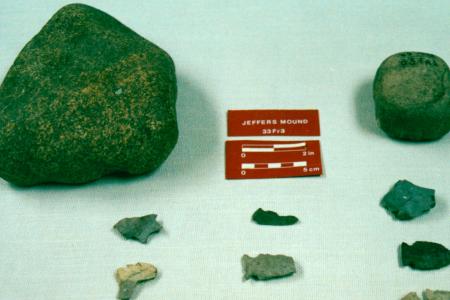
Located on Plesenton Drive overlooking the Olentangy River, the Jeffers Hopewell Mound is believed to have been built by people of the Hopewell culture sometime between 100 BC and 400 AD. The Hopewell culture was not a specific tribe, but rather refers to a way of life that evolved among people throughout the Midwest, with its epicenter in Ohio. The Jeffers Mound was once part of a much larger earthworks that was likely used as a ceremonial site. While farming destroyed much of the earthworks over the decades, the Jeffers Mound has been preserved and is on the National Register of Historic Places. Although it is not officially part of the Ohio Hopewell Earthworks that in 2023 were designated as a UNESCO World Heritage site, it was made by people from the same culture.
As the village of Worthington was becoming established in the decades after 1803, with white settlers arriving and clearing away forests to begin their settlement, a similar story was playing out across Ohio. The Northwest Ordinance of 1787 stated: "The utmost good faith shall always be observed towards the Indians; their lands and property shall never be taken from them without their consent; and, in their property, rights, and liberty, they shall never be invaded or disturbed, unless in just and lawful wars authorized by Congress; but laws founded in justice and humanity, shall from time to time be made for preventing wrongs being done to them, and for preserving peace and friendship with them." However, as white settlers arrived in the Midwest, the promises of the Northwest Ordinance were broken as the settlers claimed lands that had previously been occupied by Native Americans.
The Indian Removal Act of 1830, in the words of scholar Rebecca Wingo, PhD, "empowered and emboldened states to remove entire nations from their rightful homelands through physical and cultural violence. Ohioans set their sights on the fertile lands of the Grand Reserve where the Wyandot spent decades establishing houses, churches, farms and legible evidence that they made good neighbors." On July 11, 1843, the Wyandots were forced from Ohio on a weeklong walk to Kansas City, during which there were three deaths, including an infant and an elderly woman.
Two members of the Wyandot tribe notably had ties to the Worthington area. The Wyandot chief Shateyaronyah (known by white settlers as “Leatherlips” because he kept promises to the settlers, meaning his word was as tough as leather) signed a treaty with the settlers, angering his fellow Wyandots as well as the Shawnee chief Tecumseh. As a result, in 1810, Leatherlips was sentenced to death and executed in Powell, at the site of the present-day Scioto Park where a large stone sculpture now stands in his memory.
Kihue, known also as Bill Moose, was believed to be the last full-blooded member of the Wyandots to live in Ohio. He grew up in the Dublin area, traveling with the Sells Brothers Circus in the late 1800s and then settling in Columbus in a shack at the corner of Indianola Avenue and Morse Road. He was well-known by people all over central Ohio, and when he passed away in 1937 at age 99, thousands attended his funeral, which was handled by Rutherford Funeral Home of Worthington.